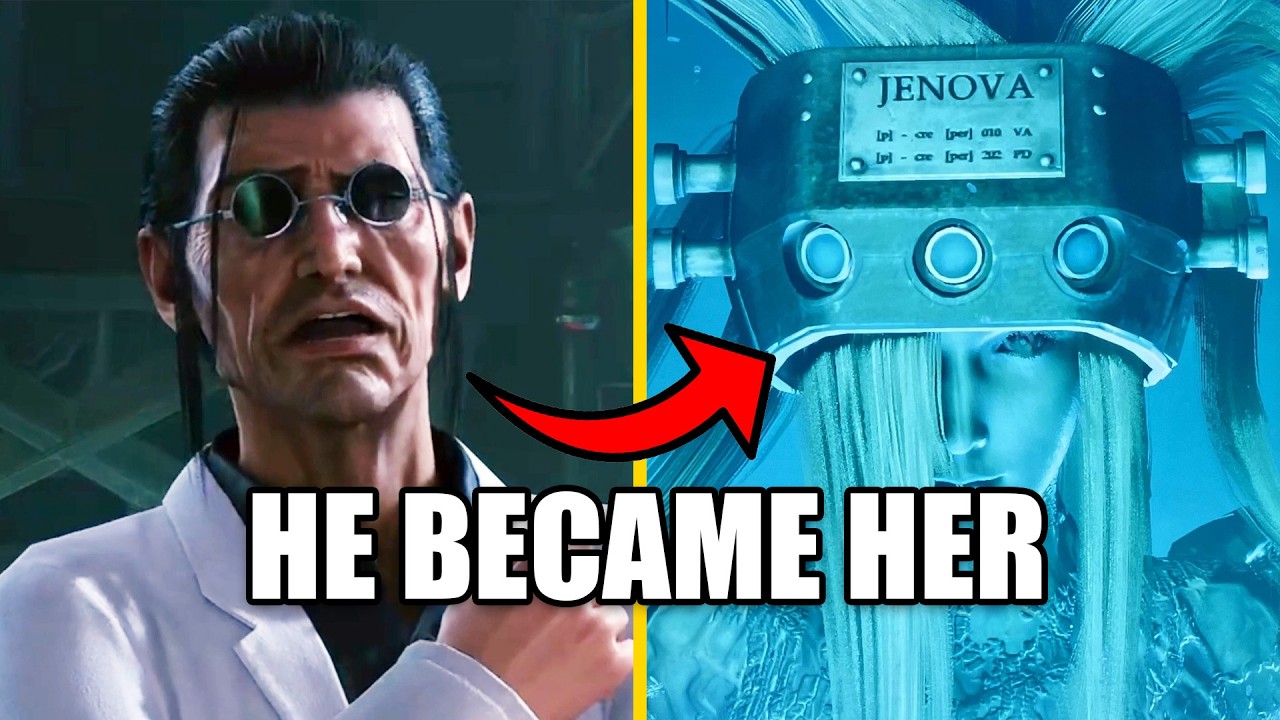
Everyone knows Hojo as Final Fantasy VII’s mad scientist, the man behind the Jenova Project. But here is a darker reading of his story. Hojo did not simply study Jenova. He spent 30 years trying to become her. Everyone assumes Sephiroth was the intended product of the Jenova Project, but what if Sephiroth was only a prototype, and the experiment Hojo really wanted to complete was on himself?
This is part of my ongoing FF7 lore series, and it follows on from the truth about Jenova that most players get wrong. If you have not read that yet, it is worth starting there.
Who Is Hojo in FF7?
On paper, Hojo is Shinra’s head of research and development, the company’s top scientist. In practice he is the architect of nearly every catastrophe in Final Fantasy VII’s universe, and most players walk straight past the full scale of what he has done. One detail tells you a lot. Sephiroth, who feared almost nothing, called Hojo a walking mass of complexes. He respected Professor Gast, the scientist who led the project before Hojo, but despised the man who replaced him.

That contrast matters. Gast and Hojo worked on the same project with the same material. One of them walked away when he discovered the truth, and the other did not. That decision is where everything in this story begins.
The Jenova Project and the Man Who Walked Away
Long before the start of FF7, Shinra discovered alien remains buried in a geological layer around 2,000 years old. Professor Gast, Shinra’s leading scientist at the time, looked at the humanoid body and drew the wrong conclusion. He identified it as one of the Cetra, the ancient race who communed with the planet, and named it Jenova. The Jenova Project was born from that mistake. Its goal was to engineer a modern Cetra who could lead Shinra to the Promised Land, a place believed to be full of limitless Mako energy.

The project split into two competing branches. Dr. Hollander led Project G, which produced Genesis and Angeal, while Hojo led Project S, which produced Sephiroth. Project S was deemed the success. Then Gast discovered the awful truth. Jenova was not a Cetra. It was the creature the Cetra had gone to war against, an alien that infiltrated their civilisation by taking the form of people they loved and destroying them from within.
The moment Gast understood what Jenova really was, he walked away from the project completely. Hojo took over and never looked back. One man saw what Jenova was and left. The other saw the same truth and moved even closer. And the one man in this story with a genuine conscience, Hojo would later hunt down and kill.
Lucrecia and Hojo’s Unborn Child
The first experiment Hojo ran once he was in charge was on his own unborn child. Lucrecia Crescent was a scientist on the Jenova Project, and she was carrying Hojo’s baby. With her agreement, Hojo injected Jenova cells directly into the unborn child. That child was Sephiroth, fused with an alien organism before he took his first breath.
Sephiroth never knew. Hojo told him his mother’s name was Jenova and that she died giving birth to him. He even gave Sephiroth a photograph of Lucrecia, his real biological mother, and told him it was Jenova. He built his son’s entire identity on a lie and sent him into the world to live it.

Lucrecia was never even allowed to hold her baby. She spent the rest of her life broken by grief and guilt, and when she tried to end her life, she could not, because the Jenova cells she absorbed during the pregnancy made her biologically unable to die. She ends up sealed in a crystal in a cave, neither fully alive nor at peace, trapped with what she helped create.

One man did try to stop this: Vincent Valentine, a Turk assigned to protect the scientists. When he confronted Hojo about the ethics of injecting an unborn child with alien cells, Hojo’s response was immediate. He shot him, then used Vincent’s body for further experiments, fusing him with an entity called Chaos and leaving him with an immortality and transformations he never wanted. Hojo’s clinical verdict on the result was simply another failed experiment.
Gast, Ifalna and the Truth Hojo Buried
After leaving Shinra, Gast did what he never could inside the company and researched the Cetra properly. He found Ifalna, one of the last true Cetra, and the two married and had a daughter: Aerith. Gast documented everything. Ifalna told him Jenova’s real history, the infiltration, the ancient war and what Jenova actually was, and for the first time the complete picture existed outside Shinra’s control.

Hojo tracked them down. Gast was killed, and Ifalna and baby Aerith were taken. Ifalna eventually escaped with her daughter but did not survive for long, and Aerith grew up in Hojo’s labs, the last living Cetra, studied as a specimen by the man who destroyed her family. Gast had the only complete account of Jenova’s true nature, and Hojo made sure it died with him.

Nibelheim: An Entire Town Erased
When Sephiroth learned the truth about his origins, not from Hojo but from Gast’s old research notes in the Shinra Mansion basement, he burned Nibelheim to the ground, killed its residents and went to the Mako reactor to meet his mother. Cloud and Zack fought him, and Sephiroth fell into the Lifestream. What happened next is the part FF7 tells you least about.

Hojo arrived during Shinra’s cleanup and saw an opportunity. He took the Nibelheim survivors, including Cloud and Zack, and used them to test his Reunion theory: the idea that Jenova’s separated cells would be biologically driven to come back together. He injected them with Jenova cells, Mako and Sephiroth’s genetic material. Successful subjects were tattooed with numbers. Failures were left to die, and nobody knows exactly how many people were destroyed.

Cloud and Zack were held for roughly four years. Zack’s SOLDIER conditioning meant the cells could not quite break him, but Cloud developed severe Mako poisoning and was left catatonic. His traumatised mind, flooded with Jenova cells, began imprinting Zack’s memories and abilities onto his own. Combined with Tifa’s memories of him and his desperate need to become the SOLDIER he always wanted to be, Cloud built a false identity without ever knowing it. Every vulnerability Sephiroth later exploits in Cloud was created by Hojo’s cells.

Then Hojo had Shinra demolish Nibelheim and rebuild it from scratch, repopulating it with company agents pretending to be the original residents. An entire town of people was erased and replaced. And all of it was pointing somewhere.
Hojo Copied Jenova’s Method, Step for Step
Look at what Jenova does. She places herself inside a host. She uses her cells to steer that host towards her goal. She survives destruction by scattering and reconverging. And eventually she drains an entire world and moves on to the next.
Now look at Hojo. He spent his career placing Jenova cells in hosts: Sephiroth, SOLDIER candidates, the Sephiroth copies and finally himself. He studied how those cells influence behaviour and designed the Reunion to understand reconvergence. He survives death by scattering his consciousness and pulling it back together. And his final plan is to drain the planet’s Lifestream and travel through space to a new world. Hojo did not study Jenova’s process from the outside. He adopted it from the inside.
Hojo’s Self-Experiment and the Sister Ray
Near the end of the original game, Hojo injects himself with Jenova cells. He also sabotages the Sister Ray, Midgar’s enormous Mako cannon, overloading the city’s reactors with no concern for the people inside, to help Sephiroth absorb even more power. When Cloud’s party confronts him, he openly admits that Sephiroth is his son and says he wants to watch his greatest experiment reach its final stage. He is not afraid. He is delighted as the Jenova cells transform him, and he mutates through three forms before the party finally brings him down.

Dirge of Cerberus: The Final Revelation
But Hojo had already made a backup. Before he died, he uploaded a digital copy of his consciousness into the worldwide network, and years later, when the network came back online, those fragments reconverged. He called it his Neo-Reunion. In Dirge of Cerberus he takes control of Weiss, the leader of Deepground, and works towards his final objective: awakening Omega Weapon, an entity that absorbs the planet’s entire Lifestream and launches into space towards a new world.

That is Jenova’s plan exactly: the cells, the host body, the Reunion, the escape into space. Hojo did not arrive there by accident. He built towards it across his whole life, using everyone around him as a stepping stone. I cover Omega’s role in the wider story in my FF7 WEAPONs ranking, where it takes the top spot.

Final Thoughts on Hojo in FF7
Put side by side, it all adds up. Jenova places her cells in hosts to spread her influence, and so does Hojo. Jenova creates a vessel, Sephiroth, to carry out her goal, and Hojo creates the same vessel, then tries to become one himself. Jenova survives destruction by scattering and reconverging, and Hojo survives death the same way and names the process after hers. Jenova’s ultimate goal is to drain the planet and move on to the next one, and Hojo’s is identical. Sephiroth is not Hojo’s greatest achievement. He is Hojo’s proof of concept, the evidence that Jenova’s process works inside a human body. Hojo ran that experiment on other people for 30 years because, I believe, he was always planning to run it on himself last.

The most disturbing thing about Final Fantasy VII is not the alien that fell from the sky 2,000 years ago. It is the man who found her, understood exactly what she was, and decided he wanted to be that thing too. Hojo’s experiments thread through almost every villain in the FF7 universe: Sephiroth, Genesis and Angeal, the Sephiroth copies and the Deepground soldiers. So do Cloud’s fractured identity, Gast’s death, Lucrecia’s endless imprisonment and Vincent’s unwanted immortality. For the full story of the son he built, read who Sephiroth really is, or see the same events from the inside in Final Fantasy VII through Sephiroth’s eyes.
Do you buy the idea that Hojo was trying to become Jenova all along? Let me know in the comments on the YouTube video.